Confronting Hindu Majoritarianism: A Solidarity Too Costly For The CJP Politics

Ateerah Ahmed
Published

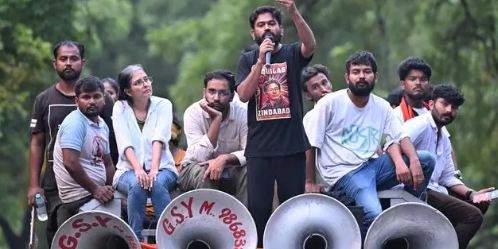
In a great deal of reporting about the barricades, the camera tower and the funnel entry points at Jantar Mantar, the containment has been presented as something that Delhi Police ‘improvised’ this time for this march. It has not been. Jantar Mantar is the only place where protest is officially allowed at all in central Delhi since 2018, when a Supreme Court judgment in the Mazdoor Kisan Shakti Sangathan case, reopened it after the National Green Tribunal had prohibited all protest at the site on environmental grounds. That judgment’s bench, Justice A K Sikri and Justice Ashok Bhushan, declared that protests are a right. However, it simultaneously ruled that nobody could claim the right to hold a demonstration at a particular place, and asked Delhi Police to create a guideline that limits protest numbers and sets a minimum distance between Parliament House, the Supreme Court and high dignitary homes. The buffer zones that made this particular march from Jantar Mantar to Sansad Marg illegal without special permission are not a July 2026 creation; they have been prescribed by the judiciary itself eight years ago. The answer the judiciary gave when confronted with the query, can protest be banned entirely, was: no, but it can be compressed.This is what changes in the whole surveillance ramp-up. AI-aided command centre and 270 body cameras are merely the latest set of hardware on a long-established architecture. What needed a discussion and analysis was that, decades into its functioning as the state's sole designated protest space, why its architecture should remain as if any protest remotely approaching power should immediately become less legal the closer it came.
By four in the afternoon on July 20, the crowd that had assembled at Jantar Mantar for the "Chalo Sansad" march that had been pushed back towards Sansad Marg by Delhi Police and the Rapid Action Force. Lathis had come out in strength initially that turned violent soon after, as the crowds funneled into alleys. Tear gas shells had been fired at regular intervals. The traffic from Connaught Place to Barakhamba Road had been snarled for hours. Mobile internet had gone down in parts of central Delhi. One of the images that made the rounds on social media that afternoon was of Sheikh Irshad Mansuri, 25, his face pitted with pellet marks, outside the Lady Hardinge Medical College.
The footage of the Rapid Action Force personnel on the ground had been scrutinized by audio-visual experts who had identified the weapon as a pellet gun, which has a well-documented history of being employed on Kashmiri protesters. The CRPF has fired over 1.3 million pellets on Kashmiri protesters as of the summer of 2016, with hundreds of Kashmiri civilians, including children, permanently injured, and blindness being a common occurrence. Similar guns have been used by the CRPF in Manipur in 2023 and in the Shambhu border incident in 2024. The use of pellet guns, curfews, internet shutdowns, and mass arrests without due process have been the norm in Jammu and Kashmir for over a decade, and not as an issue that the country's Chief Justice might have to take notice of within a week.
Even when he does take notice, he goes on to tell counsel, “we are not interested in videos”. The irony writes itself – CJP’s own acronym is derived from a statement Surya Kant made from the bench in May likening unemployed youth to “cockroaches”, who turned to activism to “attack everyone”; and Surya Kant also sat on the 2019 bench that had made granting hearing to the Jamia students conditional upon assurances of “peace.” But the question that isn't being asked is what does a "mentioning" with no immediate date for hearing achieve for a court that would rather not decide the matter at all. Refusing to hear a matter urgently does not dismiss it, leaving it in a suspended state with neither the immediate direction for appeal that the government sought nor any findings for criticism by the judiciary, saving the court the effort of recording reasons while achieving the same result: a dismissal for lack of urgency.
December 15, 2019, same city, arguably more severe violence, and a country that barely reacted with the kind of unanimity on display in July 2026. Delhi Police stormed the campus of Jamia Millia Islamia, charging into the library and using batons and tear gas to disperse the students protesting the Citizenship Amendment Act, which would have made India's citizenship policy officially majoritarian. Sixty to eighty students were injured, and another fifty were arrested, with students recounting how they had to hide under the library benches as tear gas shells rained in. The Shaheen Bagh protests that followed were a hundred-and-one-day-long woman-led show of strength that received an outpouring of global support but inside India, the response was deeply fractured.
July 2026 looks like a dress rehearsal for the events of December 2019 in terms of politics if not in scale. A Union minister was able to meet with CJP spokespersons, having received a memorandum from them. Actors and members of Parliament dropped by to personally brief Wangchuk. The Leader of the Opposition received extensive and enthusiastic coverage for his arrest. This particular student movement did not have the misfortune to be associated in popular imagination with a larger anti-national Muslim threat, and its organizers were careful to distance themselves from the idea, replacing any chants of “Azadi” with the tricolor and Bharat Mata ki Jai as soon as they realized that Shaheen Bagh was not an option. That is a clever maneuver for a disorganized and ideologically diffused movement to pull off, and it is also an implicit admission that they do not think the country's institutions would respond to them as they responded to Shaheen Bagh, if they tried. Although CJP and activists were championing ‘the right to an education’, they have been unable to take a stance against the government seeking the demolition of Al Jauhar University, a minority institution. The same nationalist rhetoric proudly celebrated by the stage-managed patriotism can offer no platform to ‘the right to minority education’ if that means confronting India’s Hindu majoritarianism.
Ateerah Ahmed is pursuing her Master’s Degree in English from Jamia Millia Islamia
Edited by: Omama Abu Talha
Disclaimer: The opinions expressed in this Publication are those of the author. They do not purport to reflect the opinions or views of The Jamia Review or its members.