
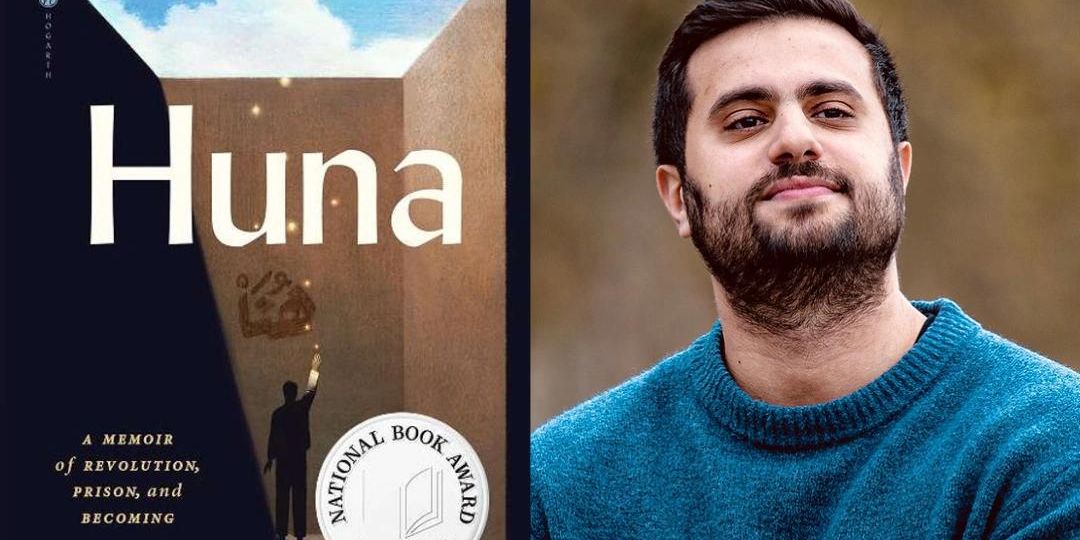
Reading ElGendy’s Huna, a torrential question maneuvered my body into the juncture where I caught languages transforming into verse. Huna means ‘here’; the title stems from an early moment in the memoir where, inside the prison, seventeen-year-old Abdelrahman ElGendy, recovering from a state of starvation, heard one of his cellmates’ nasheed Sawfa Nabqa Huna fill the space around him. Where is ‘here ’, and does it answer when the state decides where your body may be?
At any moment, you can be rebranded— your life skewed into an angle so bleak you fail to see through yourself but only through the label taped around you with authoritative care. It turns out it was not the question of ‘yourself’ but of ‘the self’, the corpse whose heart you can still hear beating, the corpse of the people wishfully ours, the corpse of the people, weak and timid before power. Huna reminds us that persecution, however blind to the present, is always direct and systemic in hindsight. That the language, however pliant, can never bend forever at the altar of oppression. That sharp vocabulary: Inmate, Parole, Defiance, Warrant, Block are bound to be softened through the force of memory and recollection.
In 2013, the Egyptian state dropped any pretence of restraint. In July, the army removed the elected president. In August, at Rabaa, security forces killed hundreds of protesters in a single day. Arrests followed by the thousand, and disappearances with them. That state believed in the power of demonstration. A person was taken not for what they had done, but so that everyone else would watch what happened to them. You could hear it in the hubris after each fresh arrest was made: setting an example had become the state's first law.
On October 6th, 2013, Abdelrahman ElGendy drove through a protest with his father when he was seventeen, when they were pulled out of their car by the brutal state forces and then assaulted on the charge of being of the Ikhwan (Islamic Brotherhood). His camera suddenly becomes the lens of the ‘other’. The guard shouts Al Jazeera. He, along with his father, would go on to be sentenced to serve fifteen years in prison for that.
_________________________________________________________________________________________
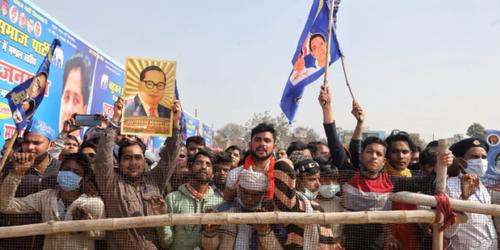
Wounded from my wakefulness as I woke up into the morning of 20th July, 2026 and having read the opening chapters of Huna, almost immediately— Delhi Police was all over the live television, whipping down the batons, cracking down on the student protesters. In a similar state of awe and shock, everything around me seemed like just another playground for oppression. Thousands had gathered at Jantar Mantar, the capital's main protest site, in a movement led by the Cockroach Janta Party, demanding the resignation of the Education Minister, Dharmendra Pradhan, over his handling of the NEET paper leak. Twenty-one students had died by suicide in its wake.
Being a Muslim in the fascist Indian State that fixates on criminalisation of that identity, this protest overarched our collective memory. It brought us back to 2020, when fighting for our existence in the country during the CAA protests, we were humiliated, tortured, arrested, and lynched, all while the majority slept on us. This latest protest over the NEET Papers was more about finding the terminology where you can invent a distance but also, through that essence, cry out solidarity. In family gatherings, they would voice repeatedly to be cautious, to not go near the protest site, all while everyone felt those beatings to their own bones. A friend, I remembered, jokingly said to me on a call, We don’t want a terrorism angle to this. My body, I thought— my political body, I thought— was not enough to change the wheel of my car but enough to dismantle a protest of millions.
On that same day, baptised with fury, I contained myself. My mother on the phone made me promise that I wouldn’t find my way to the protest site. My head instantly plucked a string that was not a voice I had heard, but one that came from the book that very morning. Habibi! It’s too dangerous! I recognised it was Abdelrahman's mother, warning him against going to the Armed Forces Day Protest, the same one that would bring him behind bars for six years.
________________________________________________________________________________________
In the wake of his capture with his father, he recounts the farshas, the changing floors on which he’d find his blame body every morning. Abdelrahman ElGendy’s brazen accounts in Huna confront more than memory the will of trust. It starts with a voice realising the downhill of what is going to come forth, the snapping process of seeing oneself obliterated again through the pages in the chasm of literatising. The trust is the marvellous angelic writing with which we are seeped deep into the consciousness of his captive teenage years. Vibrantly, he is the teen of the 2010s, carrying the emerging culture of staying free and wild with him to seclusion. His words stem up through his clear and soundful anxiety, and a sonic remorse as he finds his father is bound to his same fate. Yet his words are anything but paints of self-pity; throughout it resembles the sharp rattling of prison bars inside the groin of the authoritarian society, one that is empowered by surveillance and collective silence. In the state of hereness, it dissolves ElGendy’s past into the reimagination of his coming time.
ElGendy was a minor. Any time an officer could come to take him out of the cell, to ask for a pardon for what was a meaningless incarceration. Nothing such ever arrives. The path of waiting for the right keys to turn takes us to his memory that gets in the way of hereness. It begins with a father and a seventeen-year-old son swept up together in the crackdown after the 2013 coup, and carries them from overcrowded holding cells to the Scorpion, the country's most notorious prison complex. What the state leaves a boy in there, he uses. He forms friendships that will outlast the sentence. He studies his way to an engineering degree. And he writes, slipping pages out in laundry bags, until the pages become this book. He remembers speaking into a cellmate's hair; the politics of the prison, and its diverse economy; Hassan's rosy nasheeds; facing Mama and Salma across the visiting area; the basketball court, a stretch of borrowed time where he spoke with Fareeda. That waiting is the constant here. The waiting prospers, the waiting lurches, the waiting becomes the lubricant to the fanatic machinery of oppression.
______________________________________________________________________________________
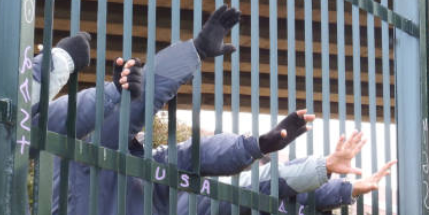
When I decide to not go to the protests, the protest comes to me on my internet. And with it comes the Arms. Stubborn Arms— Power-frenzied Arms— Arms scavenging on your personhood— Arms moving towards you with tear gas— Arms knocking down houses on a hint of your dissent.
The Arms arrive with a vocabulary. In an essay for The Nation, ElGendy describes how, after the 2013 coup, the Brotherhood was declared a terrorist organisation almost overnight, and the label did not stay where it was put. Leftists became Ikhwan. Liberals, Ikhwan. Seculars, Ikhwan. Even football Ultras, Ikhwan. If every opponent is Ikhwan and every Ikhwan a terrorist, then tens of thousands of political prisoners simply cease to exist. I recognised its vocabulary, too, in the words of the Indian ministers, who asked that "anti-national forces" not be allowed to exploit the protest.
Along the pathway to Jantar Mantar, the street was laced with CCTVs. Clamped on top of the four-wheeled beasts, on the cop’s mobile phone. In India, the bodies are currently in the government depository. No matter where you go, you will always be identified, noted, tracked, profiled. Throughout the years that followed 2014, one of the vilest registries of the resisting is being completed.
Surveillance means nothing where people don't bother being looked upon. But it should lead us to the question of what happens when the tyrant remembers every face that protests? What happens when you are somewhere in Delhi, and your home in Lucknow has already been raided, your bloodline identified, your family detained, your house maybe even bulldozed? In Kashmir, following the killing of a personnel, 3000 people were taken out of their homes and detained within a single day.
It is said that a prisoner counts time by the largest unit they’ve endured. At first, it’s hours. Once you’ve trembled through your first night, you count in days. Survive a week, and it becomes week one, week two, week three. Then it’s May, June, July. When you cross the nine-month threshold, the heft of the creeping anniversaries settles deep in your gut.
It is through the construction of this ecosystem that ElGendy brings to our vision the newly modified relationship that we can have with a cell. Suddenly we are no longer holding our ears to the walls and overhearing the rummaging breaths of hope and glory attached to the idea of confinement. We clamp and harrow on how prisons are, in fact, a place that breaks you, that despite even the fact that you’ll come out, you are— in the belly of the beast. Truth in this narrative is not cyclical; it descends. It seeps into the limbs one day and the stomach the next, in the truth of hunger:
We passed the bag around. Each person grabbed two pieces and swallowed them whole. People looked hungrier by the time the bag made full circuit.
In the truth of hearing:
The last cellmate patted down by a guard outside dared to sneak a look, and a slap resounded through the tube.
In the truth of sight and touch, truth is the relation with which we see the six years of ElGendy’s hostile incarceration.
And within all that, there are places in the book where truth is for the eyes of the one understanding. They are to be listened to rather than read. For brief moments, ElGendy turns to Arabic as a resort for being understood in the borderless wisp of the region. Occasionally, he leaves words in Arabic, untranslated, transliterated, to speak strictly to the one who can listen and who has listened to him throughout his years of turmoil behind bars. It becomes the grooves of whose climbing is hard to fetch with a coloniser’s eye.
_________________________________________________________________________________________
The protests intensified. And the protesters with the same momentum were handed over what they laboured for. The voice was heard, and everyone knew which part of that voice was heard. On 25th July 2026, the Education Minister resigned only to be replaced by Prahlad Joshi, another figure of the notorious Rashtriya Swayamsevak Sangh, the fascist outfit that has its hold over the Indian State. I saw everyone rejoice as nothing changed for me, as the iron hand did not leave the room even when the door opened once.
Huna does something revolutionary even in the context of resistance literature; it destabilises the vices associated with the life of a prisoner held on the count of politics; it destabilises the relation we have with time. I think of Sharjeel Imam, one of the key visionaries of the CAA-NRC protests, who has been in custody since 28 January 2020 as he goes on to complete seven years still behind bars. Sharjeel Imam, in one of his letters from the jail, writes, “As the years drag on, I do worry about my mother, my brother, and the world outside. I wonder if my presence could have made any difference, or if I have missed something that can never be recovered.”
__________________________________________________________________________________________
Toward the end of his memoir, ElGendy reaches America, which, in the wider imagination, stands for open space itself. The Arms followed. In March 2025, ICE agents took Mahmoud Khalil off a New York street. ElGendy found his name had appeared on a doxxing site, and that any moment he would be the next target. He packed his cases and has now fled to Europe.
What ElGendy has achieved is a premier almanac of loss, and the blueprint of what could become our collective memory when these horrors are unleashed upon us despite anything we find might protect us from it. I began Huna thinking about the language of power; I finished it reminded that language still sides with us.
About the author of Huna:
Abdelrahman ElGendy is an Egyptian writer and translator from Cairo, and the Literary Editor of The Markaz Review. He is the author of Huna: A Memoir of Revolution, Prison, and Becoming; longlisted for the National Book Award. Abdelrahman's work examines state violence, empire, and exile, attending to the entanglements of local and global oppressions and the solidarities that emerge across them.
This article is authored by Syed Kabeer Hassan, pursuing his B.A.LL.B (Hons.) in Law from Jamia Millia Islamia.
Edited by Omama A Talha
Disclaimer: The opinions expressed in this Publication are those of the author. They do not purport to reflect the opinions or views of The Jamia Review or its members.