
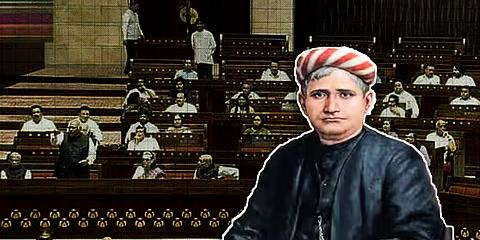
In August 2026, Parliament approved a new law, the Prevention of Insults to National Honour (Amendment) Bill, 2026, which equated Vande Mataram with the national anthem, the flag and the Constitution. The law makes wilful insult to the song and obstruction to its singing punishable by up to three years in jail. The government chose the occasion of the 150th anniversary of Bankim Chandra Chattopadhyay’s composition for the song to announce the decision and argue that protecting Vande Mataram was an overdue correction. The Home Ministry statement accompanying the legislation said that, as a song that freedom fighters laid their lives to sing, it deserved the same protection as the national anthem. Such a remark asks us to believe that Vande Mataram was merely an artefact of the freedom struggle and, in the process, ignores the song’s theological claims and political trajectory, which are intertwined with the rise of Hindu nationalism.
Anandmath, the 1882 novel in which Vande Mataram first appears, is more than a simple story of Hindu nationalism. It tells of a group of Hindu sanyasis who turn to violence when their Muslim rulers refuse to end a famine. Later printings of the novel made the antagonist less explicitly Muslim, but Bankim Chandra Chattopadhyay’s original text was far more Islamophobic. The sanyasis’ uprising was not directed against the East India Company but another Muslim-ruled region that had taken over Bengal. In the novel, Vande Mataram is presented as a hymn to Durga, the ten-armed goddess who will destroy all her foes. The later stanzas were written in the same vein as Shakta goddess cults, where Kali and Durga are aspects of one divine entity. It is this very goddess worship that gives the poem its power and serves as its defining characteristic. This is why the song could not simply be adopted whole by a movement that sought to unite Hindus and Muslims in a common cause against England.
Sri Aurobindo, who edited a nationalist paper called Bande Mataram between 1906 and 1910, subsequently wrote that he had experienced the presence of the Mother during his imprisonment and trial and that he had written a pamphlet, Bhawani Mandir, proposing the foundation of a monastery to the goddess as the centre of the nationalist movement. But instead of composing a novel and a collection of poems like Bankim, Aurobindo based his project on worship. The very language that was employed evoked the Vaishnava and Shakta traditions, creating a discourse that was devoid of muslim participation.
The RSS’s conception of the nation as motherland, “Bharat Mata”, also draws on the same principle. The goddess here rides a lion, demanding devotion, not merely patriotism, from her children. It is perhaps fitting that the RSS has never sung Vande Mataram or even Jana Gana Mana, but “Namaste Sada Vatsale” instead. It is therefore ironic that the political heirs of the RSS are now criminalising people for singing Vande Mataram, which they have consistently eschewed for decades, employing its poetic and pictorial motifs as fuel for Hindu Rashtra.
Rabindranath Tagore, who had set the poem to music and sung it before the 1896 Congress, realised the communal politics attached to it. When the Congress working committee addressed the issue in 1937, it did not prohibit the song or condemn it as inappropriate, even though it removed the allusions to Durga and Kali, retaining only the first two stanzas that describe the land in largely agrarian terms. The resolution adopted by the Constituent Assembly in 1950, which the bill under consideration now purports to follow, actually authorised only the truncated version. The 2026 bill quotes the Constituent Assembly's resolution of 1950 as giving the song "equal respect" with the anthem, which is correct, but does not mention that the song honoured was half the length of the one it replaced. In addition, government ministers speaking in the Assembly have gone beyond the text of the bill, arguing that the original shortening of the composition in 1937 was revenue measures designed to please Muhammad Ali Jinnah and that its restoration was an act of correction.
Anti-nationalism, as a legal concept, describes conduct against the state: sedition, incitement, disruption. It has never described non-participation in a devotional recitation, and the Supreme Court settled the closely analogous question in the 1986 Bijoe Emmanuel case, when three Jehovah's Witness children were expelled from school for standing respectfully without singing the national anthem. The Court held that silent, respectful non-participation is not an offence, because the relevant law exists to punish disruption, not disagreement, and because the constitutional protection of conscience does not require a citizen to perform anything to prove loyalty. The term, in recent times, seems to have adopted a different practice altogether.
The Waqf (Amendment) Act, 2025, passed by Parliament that April and now known as the UMEED Act, abolished the doctrine of "waqf by user," under which a property could be recognised as a religious endowment on the strength of long, continuous use for that purpose, a mosque or graveyard that had functioned as one for generations without ever having a formal deed. Under the amendment, only a property with a written waqfnama qualifies going forward, and where a claim is disputed, the determination now rests with the government rather than the Waqf Board itself. The Citizenship (Amendment) Act, 2019, works on the same logic from a different angle. It grants an expedited path to Indian citizenship for Hindus, Sikhs, Buddhists, Jains, Parsis, and Christians who arrived from Pakistan, Bangladesh, or Afghanistan before the end of 2014, on the premise of religious persecution, while leaving Muslims from those same countries outside the fast-track category altogether. The push toward a Uniform Civil Code follows the same instinct one step further. Personal law in India has long been plural by design: Hindu, Muslim, Christian, Parsi, and various tribal and customary systems operating in parallel, each shaped by community practice rather than a single legislative text. A uniform code does not simply update these systems; it proposes replacing plurality itself with a single legible standard, on the argument that gender equality requires it, an argument that nonetheless produces the same structural result as the other two.
The real question, therefore, becomes much greater than the mere production of the right record of service by the Muslims. It rather asks whether it was ever going to count, at all. A movement that spent decades keeping this exact song at arm's length has now made it a criminal offence not to sing it.
Ateerah Ahmed is pursuing a master's degree in English from Jamia Millia Islamia.
Edited by: Arslaan Beg