

India’s artificial intelligence boom is celebrated as a significant leap toward a silicon-built future, yet its digital economy rests upon a material foundation excavated from the commons. Beneath the narrative of technological progress lies a story of extraction where forests are cleared, aquifers contaminated, and settlements demolished, selectively displacing marginalized Dalit and coastal communities for automated server halls. From Visakhapatnam to Mumbai, state machinery and corporate power combine to orchestrate this dispossession, offering minimal permanent employment in return. Without radical structural corrections, artificial intelligence will merely become the latest vehicle for an old, unequal enclosure.
The arrival of artificial intelligence in India has been narrated almost entirely as a story of ascent, a leap from agrarian dependency into a future built on silicon and electricity. Data centre capacity has nearly tripled within five years, climbing from roughly five hundred and twenty megawatts in 2020 toward nearly one and a half gigawatts by the middle of 2025, with industry forecasts placing eventual capacity somewhere between four and a half and six and a half gigawatts by the end of the decade. Yet beneath this narrative of technological progress lies an older and more familiar pattern, one in which forests are cut down, water tables are drained, public land is enclosed, and settlements built by the poor are erased so that server halls might rise in their place. The digital economy, for all its claims to immateriality, rests upon a material foundation excavated from the commons that working people and marginalized communities have long depended upon for survival.
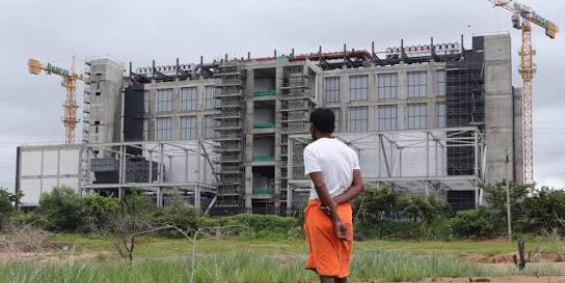
Consider what is unfolding in Visakhapatnam, where the state government has cleared land for a data hub backed by Google’s subsidiary Raiden Infotech, together with the Adani Group. Environmental groups have determined that ninety percent of the chosen site in Tarluwada lies within the notified Pedda Chukka Konda Reserve Forest, a designation that under Indian law should have triggered a far stricter appraisal process than the one the state’s pollution control authority ultimately granted. Activists allege that officials were pressured into declaring that no forest existed on the land at all, a claim contradicted by survey records and now contested before the central ministry. The irony deepens when one considers that roughly two hundred acres of this same land were originally granted to landless Dalit families during a redistribution programme meant to redress centuries of caste-based exclusion from land ownership. Although the state eventually raised its compensation offer to fifty lakh rupees per acre, many families have refused to surrender plots that represent the only inheritance their community has ever been permitted to hold, and they point out that land owned by dominant castes nearby has remained untouched by the same acquisition machinery. Hundreds of acres belonging to a local temple have likewise been transferred to private developers even as thousands of low-income families in the surrounding region continue to wait for the regularization of their own modest homes. When a short documentary detailing this displacement reached more than two million viewers online, the government issued a legal notice under the Information Technology Act, and Meta duly blocked the video within India, a sequence of events that reveals how thoroughly digital infrastructure and digital censorship have become intertwined.
A parallel story has unfolded in Mumbai, where six hundred and fifty households in Jai Bhim Nagar, a settlement of mostly Dalit families established in the late 1980s, were demolished in June 2024 at the very onset of the monsoon, clearing land reserved for redevelopment amid the expanding commercial holdings of the Hiranandani Group, whose Yotta subsidiary operates among the largest data centre parks in the country. A special investigation team appointed by the Bombay High Court later found that the order invoked to justify the demolition possessed no legal standing whatsoever and that the action directly violated a state resolution prohibiting evictions during the rains. The families remain in makeshift shelters along the roadside while legal proceedings continue at a pace far slower than the bulldozers that displaced them. To keep the city’s expanding server farms supplied with power, Maharashtra reversed earlier plans to retire ageing coal plants operated by the Tata Group and Adani Power in Trombay and Mahul, granting them long extensions explicitly justified by rising digital demand. Leaked figures indicate that Amazon’s colocation facilities in Mumbai alone consumed over six hundred and twenty-four thousand megawatt hours of electricity in a single year, a quantity equivalent to the annual needs of four hundred thousand households. The cost of this arrangement falls heaviest on Dahanu, a coastal town where particulate pollution from a coal plant supplying Mumbai has measured more than ten times the national air quality standard, withering chikoo orchards through a fungal blight carried on drifting fly ash and blackening the dried fish that local communities have sold for generations.
In Telangana, the pattern repeats itself through water rather than air. Microsoft’s data centre near Mekaguda village sits beside Tungakunta Lake, into which construction and server waste have allegedly been discharged, contaminating the shallow aquifer that more than twenty thousand residents across five villages depend upon for drinking water. Farmers describe soil rendered unfit for vegetable cultivation, agrarian labourers report chronic skin ailments from contact with the polluted water, and at least twenty dairy cattle have died after drinking from the lake over a two-year period. A public interest litigation filed by dozens of farmers remains pending before the Telangana High Court, which has so far declined to halt construction even as it admitted the case for hearing.
The same logic of enclosure extends to Gujarat’s coast, where the Adani Group’s industrial expansion at Mundra, undertaken partly to supply renewable energy credentials for data centre operators, has according to independent ground surveys resulted in the clearing of mangrove forests and the filling of tidal creeks that once served as natural drainage systems and fishing grounds for coastal communities. The destruction proceeds despite environmental clearance conditions that were explicitly written to protect this fragile ecology, demonstrating that even projects marketed under the banner of clean energy can reproduce the very dispossession they claim to remedy.
What unites these cases across such different states and ecologies is a shared plight. Microsoft’s completed facility in Mekaguda is projected to employ only one hundred and eighty people permanently. A fifteen thousand crore rupee investment in Tamil Nadu generates a mere five hundred permanent positions, whereas two other projects signed in the same agreement - an electronics manufacturing hub and a shipyard expansion, costing a combined thirty-six hundred crore rupees, less than a quarter of the data centre's outlay are projected to create seven thousand seven hundred jobs between them. Hyperscale computing, once built, requires astonishingly little human labour to sustain, since its operations are automated almost entirely. The communities that lose their forests, their lakes, their assigned lands, and their homes, therefore, receive little in permanent exchange for what they have surrendered, while the companies and state governments that orchestrate these transfers reap the lasting benefit of cheap land and compliant regulation.
If India intends to build its digital future without repeating the worst habits of its industrial past, certain corrections are no longer optional. Environmental clearances must be assessed cumulatively rather than project by project, so that the combined pressure of multiple facilities upon a single watershed or forest cannot be concealed through administrative fragmentation. Land historically assigned to Dalit and other marginalized communities deserves statutory protection against the kind of selective acquisition now visible in Tarluwada. Public disclosure of water and energy consumption should become a condition of operation rather than a matter left to leaked documents and investigative journalism. The choice before Indian policymakers is not between development and its absence but between a digital economy built through consent and one built through enclosure, and the way that choice is made will determine whether artificial intelligence becomes an instrument of shared progress or merely the latest vehicle for an old and unequal extraction.
Joel K. Albert is pursuing his Master's in English from Jamia Millia Islamia.
Edited by: Sritama Chakrabortty
Disclaimer: The opinions expressed in this Publication are those of the author. They do not purport to reflect the opinions or views of The Jamia Review or its members.