
Fiction as truth, resistance as art,
Arundhati Roy writes for those erased from the map.
From Kerala’s backwaters to Jannat graveyard,
From struggle of Kashmir to rule of mob,
Her “small things” become India’s loudest heart.
In the SOAS South Asia Institute back in 2018, Arundhati Roy expresses Jannat guest house in her second novel as a graveyard turned into a funeral home for those who have "fallen out of this very hard grid of belonging," where the prayers are "anarchic" and the people "will not allow that circle to be closed."
In her novel she blurs the line between fiction and reality because, for her, fiction is saying the same speech: "Of course, I always wonder why people think that there's some sort of bipolarity between fiction and fact. That's not true, you know. Fiction is the truth, I would say. Particularly in the era of fake news, there's nothing truer than fiction."
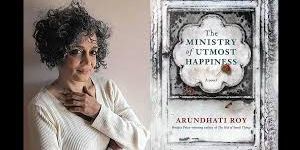
It is, however, easy to trace this statement of hers in her earliest works, for instance when she, in her first novel, creates her real yet fictitious characters and gives them the identities of Syrian, Christian and Dalit. In the similar manner, in her second novel, The Ministry of utmost happiness, she talks of Anjum, who belongs to the Shia Muslim community, stuck in the 2002 Gujarat riot, facing genocide and inhumane terror.
Roy, in her second novel explores silence and trauma in the backdrop of Gujarat riots, she has not tried to give a judgment or empathy to the character, but she has chosen to give space to the character as how it works in real life, in her novel, Anjum who has been through the riots in 2002, and eventually been spared by the riot as "Butchers luck"(she was a Hijra, and it would be bad luck for the mobs if they had killed her) and she grows with the silence in the novel, thus Roy chooses not to give her magical wings in her fiction, declaring that fiction is her truth, and Anjum as a vehicle for the human complexity of trauma and as a form of resistance for those who have had no voice.
In her seminal work, The God of Small Things, the God of small things becomes the God of small details, a contradiction of the ideals of Keralite society and their on-the-ground practices. Roy’s writing seems as if T.S. Eliot has been to India this time and is writing his magnum opus, The Wasteland, the anthology of small details from history, resistance, and emotions that do not matter in daylight, making Roy India's one of the most influential fighters and writers.
Her fiction works stand tall with her non-fiction works; for instance, in the essay The Greater Common Good (1999), talking of Kashmir and other minorities of India, she mentions, "There hasn't been a day since August 1947 when the Indian army has not been deployed against its own people within its own borders." Also, she critiques the Narmada Valley dam construction and the displacement of its indigenous people, exploring the paradox that from this project the rich will get electricity and water, and the poor will lose their homes.
It is not unknown to the surface that she is labelled anti-national in today’s India and had to fight many legal battles from the starting of her career.
For Roy, she has refused to separate art and literature from politics and liberation; probably that is why her works not only stand with the miniature of Indian caste-rotten society but also draw people from the northeastern part and Kashmir of India to many battles within her countries.
The narrative technique used by her in her novel, for instance, in her book, The Ministry of Utmost Happiness, gives voice to characters who in the normal sphere do not belong anywhere, like the people sitting on the Jantar Mantar, demanding the Just India and justice after the Bhopal gas tragedy.
This technique, however, gets transformed into her later nonfiction works, where she talks about the Tribal people and the terrors of mobs.
Reading Arundhati Roy is like looking into a mirror of the country, which is broken, unfair, and yet full of tiny, rebellious dreams. Whether in her essays or fiction, her insistence on providing space to the marginalized contradicts the nationalist narrative that aims to silence those who disagree. She views storytelling as a means of exposing, rather than escape; her "miniature" exposes the complex structure of resistance and inequality that defines modern-day India.
Rayyan Rashid is a student pursuing English Honors from Jamia Millia Islamia.
Edited by: Arslaan Beg