

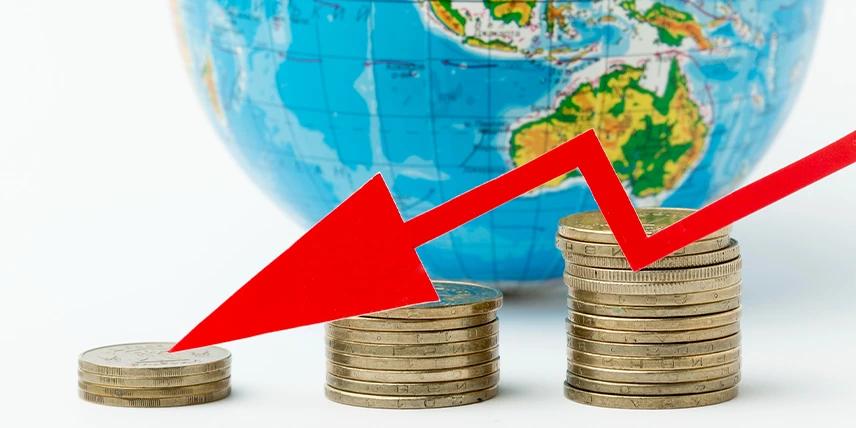
The currency of a country is frequently regarded as an indication of its overall economic condition. A trend of the Indian rupee (INR) losing its value against major global currencies, particularly the US dollar (USD), has been observed over the last few years. Although short-term changes are quite normal in any foreign exchange market, the continuous decline in the value of the rupee over the long term has raised a set of serious questions from an economic, political, and strategic perspective. To really understand what makes the rupee a falling one, one has to go beyond just the figures and get a clear idea of the basic aspects that essentially determine the value of a currency.
Historically, the Indian rupee has followed a long-term depreciating trend against the US dollar. To put it into perspective, in 1947, at the time of independence, it was ₹3.30 per USD. From the 1950s to the 1960s, it remained stable and was at ₹4.76 per USD. Further in the 1970s, it went up to ₹7.50 per USD. In the 1980s, it remained stagnant at ₹8.00 per USD. In the era of LPG in the 1990s, it went up to 17.50. In 2000, the USD–INR exchange rate was around ₹45 per USD. By 2010, it had weakened to approximately ₹46–47 per USD. In 2013, during the “taper tantrum,” the rupee briefly crossed ₹68 per USD. By 2020, the rate hovered near ₹74–75 per USD. In 2023–24, the rupee traded close to ₹82–83 per USD, marking an all-time low. Currently, in December of 2025, the rate hovered near ₹90 per USD.
This implies a depreciation of nearly 80–85% over two decades. In simpler words, where ₹45 could buy one dollar in 2000, it now takes more than ₹89 to do the same. Such numbers highlight that the issue is not merely cyclical but structural.
A Depreciating Currency Signifies that the domestic currency has lost its value relative to foreign currencies. This has a varied range of mixed implications, like the Imports becoming expensive, as India largely imports crude oil, electronics, defense equipment, and machinery. A weaker rupee directly increases import bills, leading to exports becoming competitive, as Indian goods start becoming cheaper for foreign buyers, potentially boosting exports. Another implication is that inflationary pressure rises, leading to Costlier imports translating into higher domestic prices, especially for fuel and food. And lastly external debt burden increases, and loans denominated in foreign currencies become costlier to service. Thus, the impact of a falling rupee is not uniformly negative or positive; it depends on the structure of the economy and how robust it is.
The value of a currency is primarily determined in the foreign exchange (forex) market, where demand and supply interact. Several macroeconomic and financial factors influence this balance. The first one is the Inflation Differentials, which is one of the most fundamental determinants of currency value. According to purchasing power parity (PPP), countries with lower inflation rates tend to see their currencies appreciate over time. India has historically recorded higher inflation than advanced economies like the US, Japan, or the Eurozone. For example, the average inflation rate in India (long term) is 5–6%, while in the US (long term) inflation rate is 2–3%. This inflation gap erodes the purchasing power of the rupee faster than that of the dollar, leading to gradual depreciation. The next factor is the Current Account Deficit. The current account measures the difference between a country’s exports and imports of goods and services, along with income flows. India has largely been running on a current account deficit, meaning it imports more than it exports. Numerically, India’s CAD has often ranged between 1% to 3% of GDP, and during periods of high oil prices, it has exceeded 3% of GDP. A persistent deficit increases the demand for foreign currency (to pay for imports), putting downward pressure on the rupee. Another important parameter is the Capital Flows and Foreign Investment. Foreign capital inflows—such as Foreign Direct Investment (FDI) and Foreign Portfolio Investment (FPI)—support the rupee by increasing the supply of dollars. However, global risk events can reverse these flows quickly. For instance, during global crises or US interest rate hikes, foreign investors often withdraw funds from emerging markets. Even a net outflow of $10–20 billion can significantly impact the rupee due to sudden dollar demand. Thus, the rupee is highly sensitive to global investor sentiment.
The next factor is Interest Rate Differentials, in which the Interest rates influence currency value through capital movements. If US interest rates rise faster than Indian rates, it means that Dollar-denominated assets become more attractive. Capital flows out of India toward the US, leading to Demand for dollars being increased, thereby weakening the rupee. For example, aggressive rate hikes by the US Federal Reserve have historically coincided with pressure on emerging market currencies, including the INR.
The next on the list is the Foreign Exchange Reserves, where the foreign exchange reserves act as a buffer against currency volatility. India’s forex reserves have grown substantially from around $38 billion in 2000 to peaking near $640 billion in 2021, and later moderated to around $550–600 billion due to intervention and capital outflows, while large reserves are being allowed by the central bank to smooth out the excessive volatility, as they cannot permanently stop depreciation if structural imbalances persist.
Another important factor is India's Trade Structure and Oil Dependence. India imports nearly 85% of its crude oil requirement, mainly from the Middle East. Since oil is priced in dollars, a rise in oil prices or dollar strength directly impacts the rupee. It can be interpreted as A $10 per barrel increase in crude oil prices can raise India’s import bill by $15–20 billion annually. This worsens the trade deficit and increases dollar demand, leading to Energy dependence, thus embarking it as a key structural weakness for the rupee.
The last on the list is Economic Growth and Productivity. Currencies of countries with strong productivity growth and export competitiveness tend to strengthen over time. While India has achieved impressive GDP growth rates (often 6–7%), productivity gains and manufacturing export shares remain relatively modest compared to East Asian economies. Without a sustained rise in high-value exports, long-term currency appreciation becomes quite difficult for us.
Is a Weak Rupee Always Bad? Not necessarily, as many fast-growing economies have historically tolerated moderate currency depreciation to support exports. The key concern is disorderly or rapid depreciation, which can trigger chronic inflation, erode investor confidence, and increase external vulnerability. A stable but competitive rupee is often preferable to an artificially strong one.
The falling rupee is not the result of a single policy failure or short-term shock; it is the outcome of structural factors such as inflation differentials, current account deficits, oil dependence, and global capital movements. Numerical evidence over the past two decades shows a steady depreciation trend, reflecting deeper economic realities rather than mere speculation.
Ultimately, a currency’s value mirrors the strength, resilience, and productivity of the underlying economy. Sustainable improvement in the rupee’s long-term outlook will depend on boosting exports, reducing import dependence, maintaining macroeconomic stability, and enhancing investor confidence. Until then, the rupee’s fall should be understood not just as a crisis, but as an economic signal demanding structural reform rather than short-term fixes.
Arsalan Khan is a student pursuing Electrical Engineering at Jamia Millia Islamia
Edited by: Omama Abu Talha
Disclaimer: The opinions expressed in this publication are those of the author. They do not purport to reflect the opinions or views of The Jamia Review or its members.