
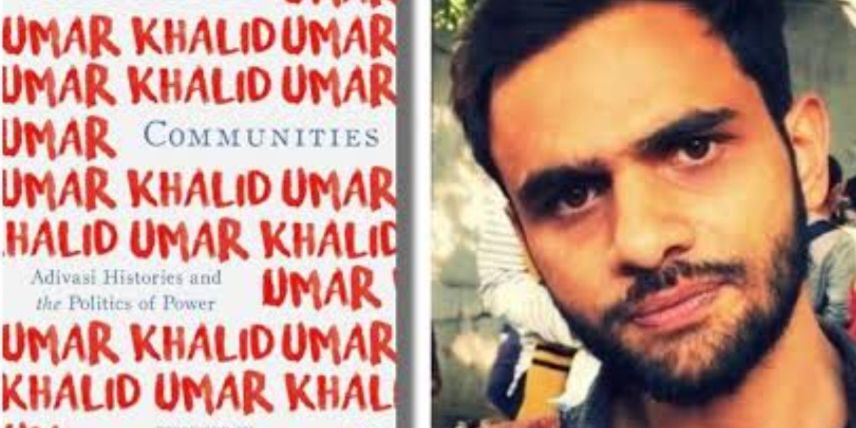
The publication of Umar Khalid's doctoral thesis, Fractured Communities, by Juggernaut Books in June 2026, is a major political event in itself. The author is presently being detained in Tihar Jail without trial, more than six years into pre-trial detention under India's Unlawful Activities (Prevention) Act, and the book still makes its way through. Khalid's thesis advances a fractured argument that communities are essentially heterogeneous and can never be reduced to the unified blocs that power, colonial or majoritarian, requires them to be, drawing on archival research into the Adivasi communities of Singhbhum under British colonial rule. This article argues that the theoretical methodology underlying this finding strikes at the epistemological foundations of Hindutva. It also turns on the vocabulary of "Adivasi" itself, a term with its own origin, its own region, its own limits, which in turn disciplines the argument against Hindutva's “Vanvasi” project.
Thre is a tendency in liberal commentary on the BJP-RSS project to treat it as an ideology that can be opposed through ordinary political means of elections, coalitions, and civil society mobilization. In contrast, Hindutva functions less as a political program than as a claim about history, and the entire movement draws its momentum from that claim. It follows the classic argument of the existence of an ancient, continuous, and essentially unified Hindu civilization that constituted the authentic identity of the Indian subcontinent before it was successively violated by medieval Muslim conquest, British colonialism, and finally by a secular nationalist elite that denied Hindus the recovery to which history entitled them. Everything else follows from this fundamental thesis. The Citizenship Amendment Act functions as a historiographical act as much as an immigration statute, encoding into law the claim that India's authentic relationship with the world is defined by Hindu civilization’s boundaries. The Vanvasi Kalyan Ashram's decades-long work among Adivasi communities rests on more than a welfare rationale. It is founded on the claim that forest-dwelling tribal communities are originally Hindu people alienated from their civilisational roots by Christian missionary interference and requiring restoration to their authentic identity, a process the movement calls “Ghar Wapsi.” Hindutva, therefore, needs a historical grounding to produce its present, and that is precisely why it needed to capture the universities, and why Umar Khalid's thesis, whatever else he may have said or done, was always going to translate itself into an issue for the State machinery.
The terminologies in question, “tribal,” “adivasi,” and “vanvasi,” indicate more than a vocabulary preference, as each term carries within it a theory of origin. "Tribe" is the oldest of the three, and it is a colonial administrative artifact before it is anything else. The colonial government needed a populace that could be taxed, settled according to land records, and governed by tribunals of customary law separate from regular courts.
"Adivasi" is most commonly understood, in this context of administrative flattening, as a self-designation, the meaning of which, “adi” (first) and “vasi” (inhabitant), contributes to the discourse on the evolution of the concept of Adivasi in a manner that gives primacy to indigenous people ahead of colonial imposition and ideology of Hindutva. This is not inaccurate but is slightly incomplete. The term originated in the specific political context of constitutional demand in the Chotanagpur region in 1938 by the Adivasi Mahasabha under Jaipal Singh Munda, campaigning for a separate province encompassing Chota Nagpur and the Santhal Parganas. It was never a pan-Indian self-designation waiting to be suppressed by Hindutva's "Vanvasi.” According to Virginius Xaxa, the notion of "Adivasi" has been used for a long time in many regions of eastern, northern, and southern India. Still, in the northeastern region, where the highest concentration of indigenous tribal peoples exists in the country, the term has not been applied. B.K. Roy Burman goes further, arguing "Adivasi" should be avoided altogether when discussing indigeneity outside its home ground, since using it there doesn't describe an existing self-identification; it imposes one.
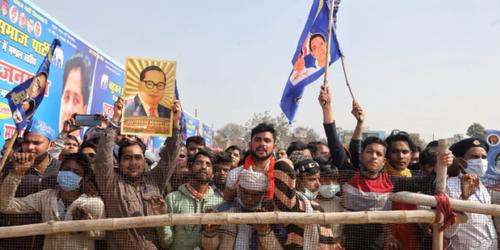
This is precisely where "Vanvasi" comes in, purposefully refuting the Adivasi assertion in whatever region it targets. “Vanvasi” simply means forest-dweller (“van,” forest; “vasi,” inhabitant), which substitutes a temporal claim for a spatial one. Where "Adivasi," in the regions where it genuinely is a self-designation, asserts primacy (these are the first people), "Vanvasi" reduces that same group to a geographical coincidence of forest dwellers without any claims of precedence. Since they do not wish to acknowledge that these communities existed before other groups, members of the Sangh Parivar have used the term tribal over Adivasi. The term reintegrates them into the Hindu fold as a marginal population that needs to recuperate from the corrupting impact of conversion.
Fractured Communities is about the Adivasi communities of Singhbhum under British colonial rule, with the central argument that these communities were internally fractured. They differed in their social organization and were contingent in their responses to colonial power; therefore, they were irreducible to any cohesive bloc of "tribal" resistance or tribal identity. This internal complexity is thus suppressed by the homogenizing tendency of histories written from positions of power, which in turn produces a politically legible but historically false figure of the unified community.
Singhbhum sits inside Chota Nagpur and its adjoining tracts, the very region where "Adivasi" as self-designation genuinely does hold, where the Adivasi Mahasabha's own struggle originated in 1938, and where the term's political history is an indigenous invention against colonial and “dikus” (outsider) power rather than an imposition from outside the region. The essential RSS's Adivasi claim in this belt is that Adivasis are Vanvasis, forest-dwelling Hindus whose animist practices are continuous with Hinduism and who require recovery from the missionary taint. However, the ideological framework of "Ghar Wapsi" crumbles for the very groups it targets when that essence is removed, and archival evidence is used to show that what really occurred was fracture, contingency, internal difference, and negotiated adaptation to colonial power.
While Khalid demonstrates that Adivasi communities under colonial rule were distinct, contingent, and irreducible to a unified bloc, genealogical descent reveals that the very word used to name those communities is differentiated in its usage and contingent on a specific region. Whether that unity is imposed on a modern tribal population by a Hindutva cultural-recovery campaign, on a colonial-era community by a district collector's settlement record, or on the entire discursive field, they all reject the same unquestioned assumption of sameness between discrete units.
Kurmis have been categorized as Other Backward Classes (OBCs). Recently, however, the group has begun to assert their Sarna Hindu identity and is waiting to be categorized as a Scheduled Tribe in the upcoming census. Tribes such as the Munda, Oraon, and Santhal have strongly protested the move to categorize the Kurmis as Scheduled Tribes. Jharkhand has a 7.5 percent Scheduled Tribe population, which is already divided among 32-odd tribes. If the figure were to be divided further among more claimants, the same fixed quantum of seats reserved for Scheduled Tribes, forests reserved for their use, and government jobs would only get divided. Therefore, the struggle is taking place only within the four walls of the existing legal structure without relying on that insidious concept of ‘essence’ shared by the Munda, Oraon, and Santhal tribes and lacking in the Kurmis. This highlights the difference between the Vanvasi Hindutva move from above to dismantle the Adivasi category and merge it into the larger Hindu population and the already acquired legal category being fought and even fragmented among already established incumbent groups and the new claimants for limited resources, including quotas of seats, preserved forests, and government jobs, as well as their count in the censuses.
The Hindutva project has spent decades changing the past. This includes altering textbooks, renaming cities, and framing temple-mosque disputes as arguments for rightful ownership. Even efforts for tribal welfare have been recast as a recovery of civilization. The state claims that Khalid is a conspirator against the republic. They argue that his speeches led to mass violence and that he poses such a serious threat that six years of pre-trial detention without a verdict are warranted. The state's ability to define who truly participates in national life depends on a certain consistency. Labeling someone as "anti-national" means that credible institutions cannot view those identified as valuable contributors to national thought. This leads to a particular type of violence: silencing someone through noise rather than silence. Khalid has been labeled as a “terrorist,” “conspirator,” “mastermind,” and “anti-national,” which risks hiding the scholar behind these accusations. However, when a “terrorist” and an “accomplished doctoral scholar” turn out to be the same person, the state’s portrayal appears less like an accurate representation and more like a convenient tool. Publishing Fractured Communities thus becomes more than a book launch- it becomes an act of excavation.
Ateerah Ahmed is pursuing her Master’s Degree in English from Jamia Millia Islamia
Edited by: Omama Abu Talha
Disclaimer: The opinions expressed in this Publication are those of the author. They do not purport to reflect the opinions or views of The Jamia Review or its members.